New Diagnostics for Dimensionality Reduction

Speaker: Kris Sankaran, PhD | Assistant Professor of Statistics, Discovery Fellow, Wisconsin Institute for Discovery, University of Wisconsin–Madison

Date: Tuesday, Aug 18th, 2026

Time: 10:00 AM Central Time

Location: Zoom

Title: “New Diagnostics for Dimensionality Reduction”
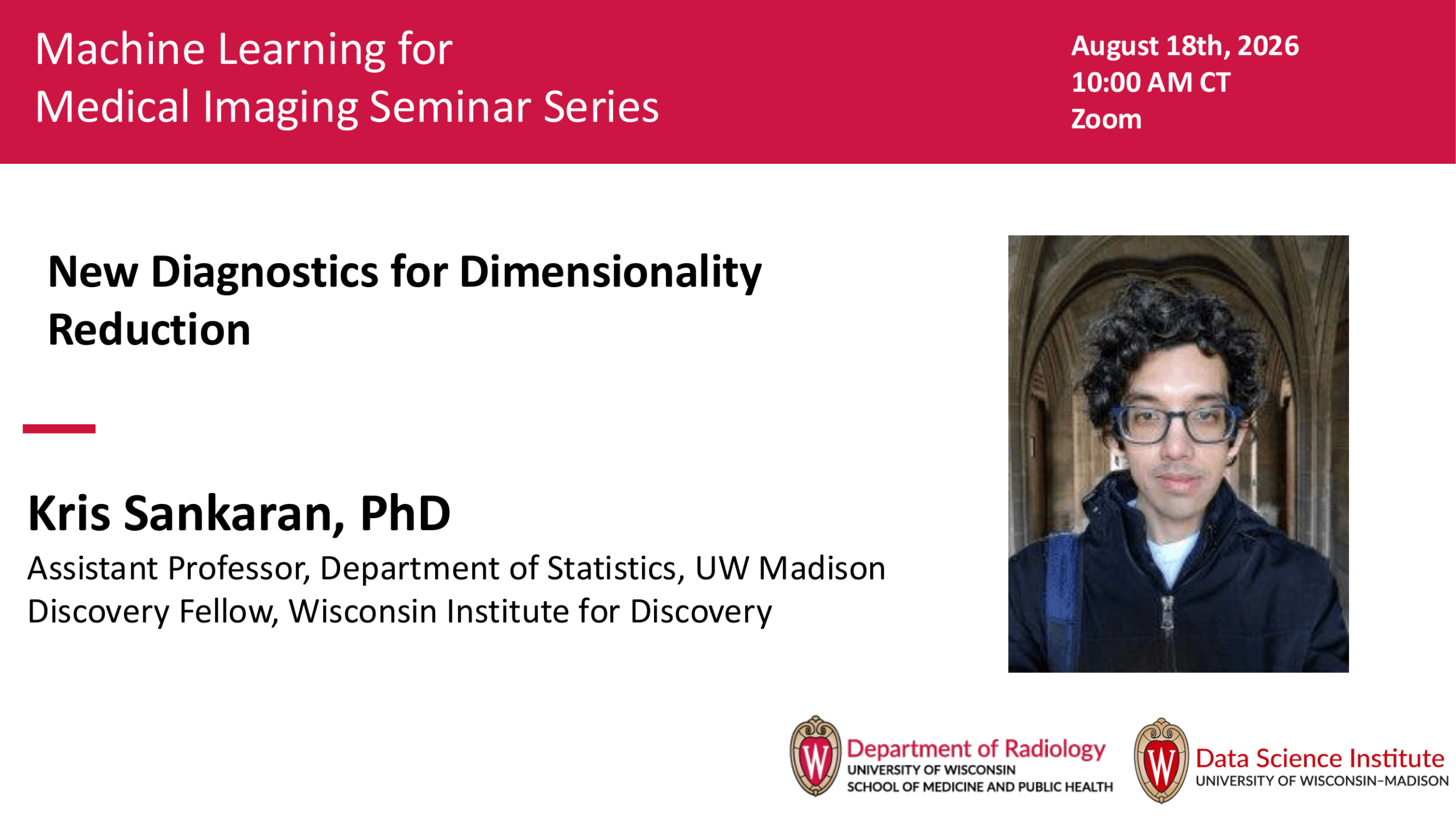
Abstract: Dimensionality reduction helps organize high-dimensional data into low-dimensional representations, like differentiation trajectories in single cell data and functional units in neuroimaging data. Such reductions are powerful but sensitive to hyperparameters and prone to misinterpretation. This talk addresses two risks in dimensionality reduction. First, we consider how to choose the number of topics K in topic modeling, a matrix factorization technique well-suited to high-dimensional counts and closely related to nonnegative matrix factorization. While broadly useful, topic models require users to specify the number of topics K, which governs the resolution of inference. We discuss a new technique, topic alignment, for comparing tpoics across models with different resolutions. Simulation studies show that this approach distinguishes between true and spurious topics. Second, we examine the distortions introduced by nonlinear dimensionality reduction methods, like t-SNE and UMAP. For example, these methods can introduce spurious clusters and fail to preserve sample density. We adopt the RMetric algorithm from manifold learning to measure local distortions. We also develop visualizations to explore these distortions. Representing samples as deformed ellipses highlights changes in local geometry, and an interactive interface selectively reveals evidence for distortion without overwhelming the viewer. Through case studies on simulated and real data, we find that the visualizations can flag fragmented neighborhoods, support hyperparameter tuning, and enable method selection. Topic alignment and distortion visualization are available as software packages, with case studies in online vignettes: https://go.wisc.edu/7h58r9, https://go.wisc.edu/ss5ts9.
Bio: Kris Sankaran is an assistant professor in Statistics Department at UW-Madison and a discovery fellow at the Wisconsin Institute for Discovery. His group develops methods for visualization, simulation, and integration of high-throughput biological data. They actively develop statistical software to support practical multiomics projects, from experimental design to interpretation. The lab has been supported through grants from the NSF, NIH, the Gates Foundation, and the Starry Night Foundation. Kris completed his postdoc at the Mila – Quebec AI Institute in 2020 and his PhD at Stanford University in 2018.