Date: Tuesday, March 17th, 2026
Time: 10:00 AM Central Time
Location: Zoom
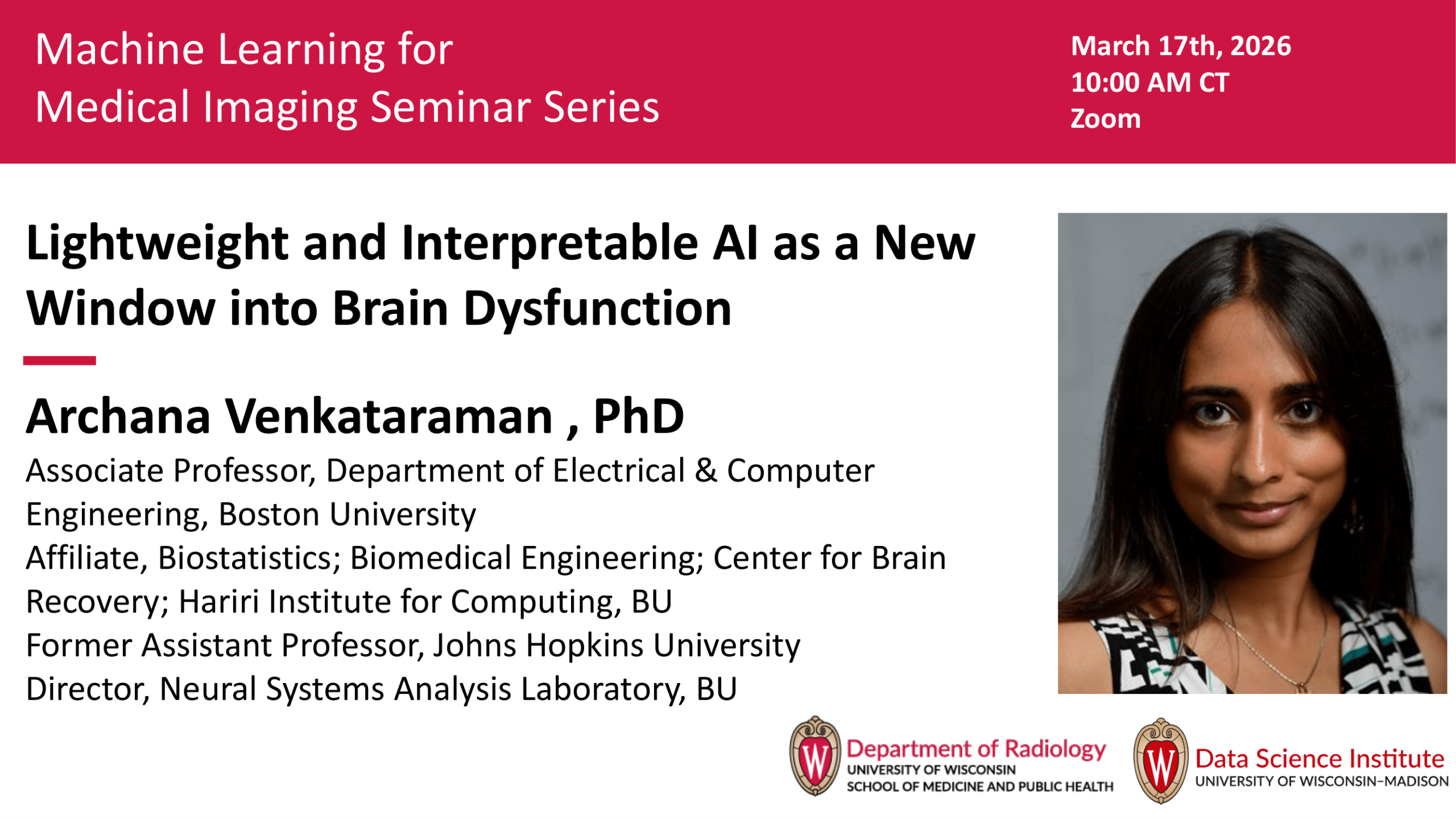
Title: “Lightweight and Interpretable AI as a New Window into Brain Dysfunction”
Abstract: Deep learning has disrupted nearly every major field of study from computer vision to genomics. The unparalleled success of these models has, in many cases, been fueled by an explosion of data. Millions of labeled images, thousands of annotated ICU admissions, and hundreds of hours of transcribed speech are common standards for AI models. Clinical neuroscience is a notable holdout to this trend. It is a field of unavoidably small datasets, massive patient variability, and complex (largely unknown) phenomena. My lab tackles these challenges across a spectrum of projects, from answering foundational neuroscientific questions to translational applications of neuroimaging data to exploratory directions for probing neural circuitry. One of our key strategies is to develop both lightweight and interpretable models using domain knowledge.
This talk will highlight two ongoing lines of work that epitomize this strategy. First, I will showcase an end-to-end deep learning framework that fuses neuroimaging, genetic, and phenotypic data, while maintaining interpretability of the extracted biomarkers. Specifically, the network uses hierarchical graph convolution that mimic the organization of a well-established gene ontology to track the convergence of genetic risk across biological pathways. We use a learnable dropout layer to extract a sparse subset of predictive imaging features and a biologically informed deep network architecture for SNP-level analysis. Second, I will snapshot our work on epileptic seizure detection from scalp EEG. We use a transformer architecture to combine spatial and temporal information in the continuous EEG recordings. Our model accurately pinpoints, not only the time of seizure onset, but the involved areas of the scalp across a large clinical dataset. From here, we ask the question: what specific attributes of the EEG signal lead the model to a seizure prediction? To answer this question, we use a contrastive training mechanism to align the EEG encodings from the model with textual concept embeddings derived from clinical notes. Using an attention-weighted pooling mechanism, we then detect patient-specific seizure and baseline etiologies.
Bio: Archana Venkataraman is an Associate Professor of Electrical and Computer Engineering at Boston University. From 2016-2022, she was an Assistant Professor at Johns Hopkins University. Dr. Venkataraman directs the Neural Systems Analysis Laboratory and is affiliated with the Department of Biostatistics, the Department of Biomedical Engineering, the Center for Brain Recovery, and the Rafik B. Hariri Institute for Computing at Boston University. Dr. Venkataraman’s research lies at the intersection of biomedical imaging, artificial intelligence, and clinical neuroscience. Her work has yielded novel insights into debilitating neurological disorders, such as autism, schizophrenia, and epilepsy, with the long-term goal of improving patient care. Dr. Venkataraman completed her B.S., M.Eng. and Ph.D. in Electrical Engineering at MIT in 2006, 2007 and 2012, respectively. She is a recipient of the MIT Provost Presidential Fellowship, the Siebel Scholarship, the National Defense Science and Engineering Graduate Fellowship, the NIH Advanced Multimodal Neuroimaging Training Grant, numerous best paper awards, and the National Science Foundation CAREER award. Dr. Venkataraman was also named by MIT Technology Review as one of 35 Innovators Under 35 in 2019.